
20November
How PROcan fits into Emergency Response
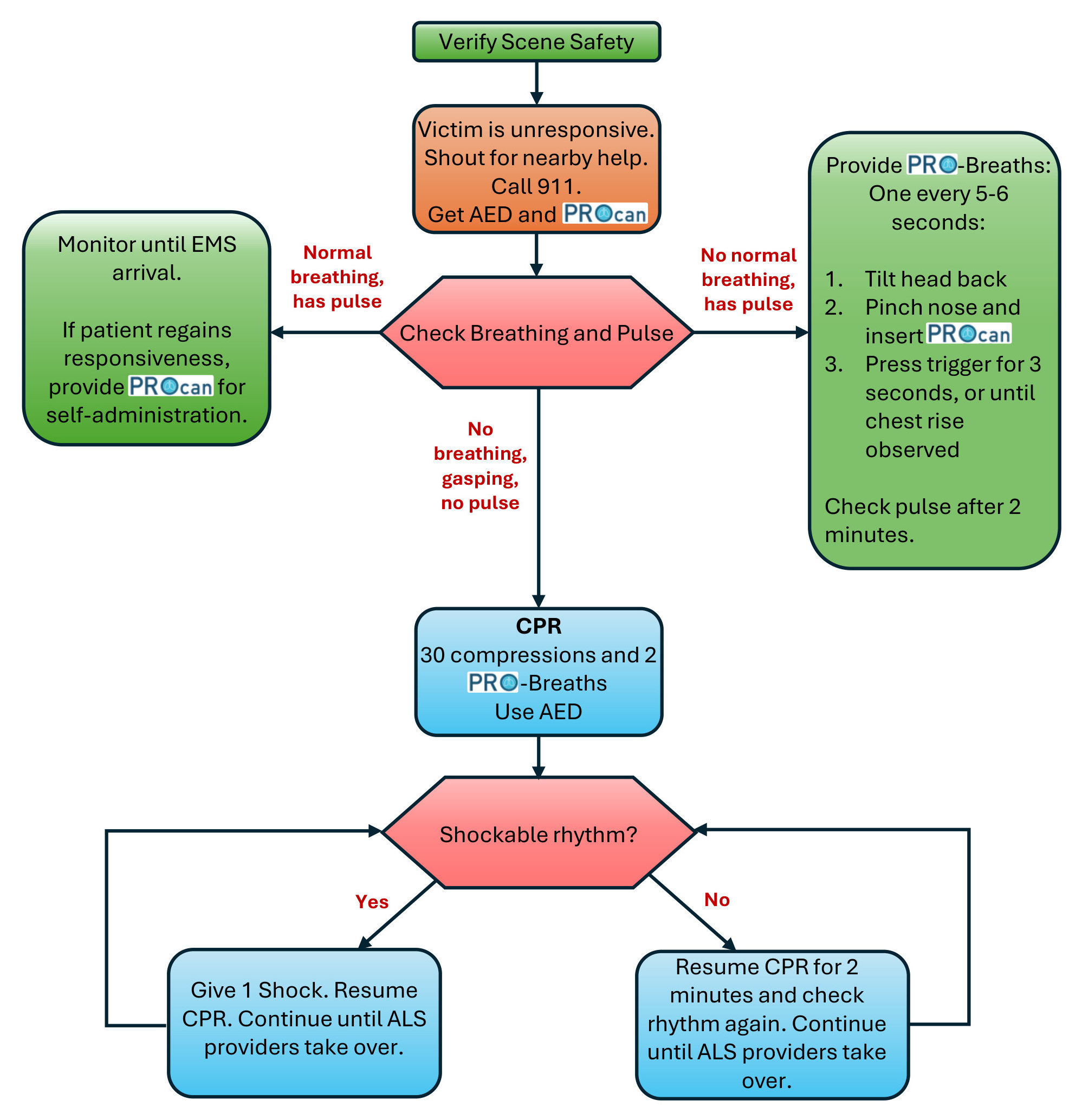
PROcan™ is designed to fit alongside these established practices by supporting oxygen-rich rescue breaths within familiar resuscitation workflows.
Call 911, begin CPR, use an AED as soon as possible, and continue care until advanced care arrives.
Every second matters during a medical emergency.
Current emergency response protocols emphasize rapid recognition, activation of EMS, early CPR, and early defibrillation.
Step 1: Recognize the Emergency
If a person is unresponsive, act immediately.
- Ensure the scene is safe.
- Shout for nearby help.
- Call 911.
- Get an AED and PROcan™ if available.
Step 2: Assess Breathing and Pulse
After determining that the person is unresponsive, check breathing and pulse.
Normal Breathing + Pulse
Monitor the person until EMS arrives. If they regain responsiveness and can breathe independently, continue to observe and follow emergency guidance.
No Normal Breathing + Pulse Present
This may indicate a respiratory emergency. Rescue breaths can be an important part of care in situations such as drowning, opioid overdose, or respiratory arrest.
PROcan™ may be used to support rescue breathing while following established emergency response procedures.
Continue to Step 3.
Step 3: Begin CPR if No Pulse Is Present
If the individual is not breathing normally and no pulse is present, begin CPR immediately.
CPR Priorities
- Provide high-quality chest compressions.
- Use an AED as soon as possible.
- Give rescue breaths when appropriate and when the rescuer is willing and able.
- Continue CPR until EMS arrives or the person shows signs of recovery.
PROcan™ is designed to complement these efforts by supporting oxygen-rich rescue breaths during CPR while maintaining the familiar cycle of compressions and ventilations.
Step 4: Use AED
After CPR has started, apply the AED and follow its voice prompts.
Shock Advised
Deliver one shock and immediately resume CPR.
No Shock Advised
Continue CPR and reassess according to AED instructions.
Throughout this process, CPR should continue until advanced medical personnel take over or the person shows signs of recovery.
Where PROcan™ Fits
PROcan™ is intended to work alongside—not replace—established emergency response measures.
Emergency Priorities
- Call 911 immediately
- Begin CPR promptly
- Use an AED as soon as possible
- Continue care until EMS arrives
How PROcan™ Supports Care
- Supports oxygen-rich rescue breaths
- Fits alongside CPR and AED use
- Supports ventilation during emergencies
- Supports care until advanced providers arrive
By fitting within familiar emergency response workflows, PROcan™ helps support rescuers during critical moments when oxygenation and ventilation are needed.
Important: PROcan™ is intended to complement established CPR and emergency response protocols. Always follow local training, AED prompts, and the instructions of emergency medical personnel.
Similar blogs
24June
PROcan™ Head of Product Development & Operations, Anne-Marie Freeley, was delighted to be featured on the In the Arena podcast, hosted by the LifeVac team....
23June
PROcan™ was proud to attend the American Society of Safety Professionals (ASSP) Safety 2026 Conference & Expo, held June 15–17 in Anaheim, California. The event...
23April
PROcan™ was proud to attend the American Ambulance Association (AAA) Annual Conference & Trade Show in Las Vegas, bringing together EMS leaders, providers, and industry...